
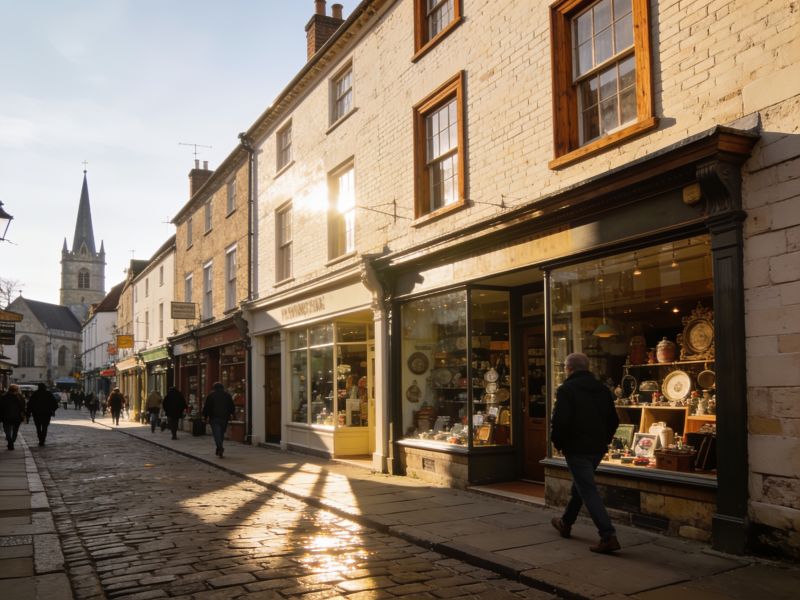
Holt's defining feature is not a castle or a cathedral but a street plan rebuilt after disaster. A fire in 1708 destroyed much of this Norfolk market town, and the replacement buildings gave Holt the Georgian spine that visitors still walk today. Stand outside the churchyard and look toward the Market Place: brick facades, slate roofs, and shopfronts set tight against the pavement. The layout feels orderly, but it is not sterile. Holt has a working town centre, not a museum set. On a Thursday market, stalls crowd the square with produce, plants, and second-hand tools;by Saturday, the same space fills with shoppers drifting between independent retailers. That mix matters. Holt survives because it is useful as well as attractive, and the town's commercial rhythm is more convincing than any heritage plaque. St Andrew's Church。just off the centre, has a tower that gives a useful bearing point;the town is small enough that most errands can be done on foot, a practical advantage that many larger market towns have lost.The town's independent retail scene is not a marketing invention. Holt has a high concentration of small shops for its size, and the absence of a large indoor shopping centre keeps the centre fragmented in a good way: a bookshop here, a hardware store there, a bakery tucked into a side lane. Bakers and Larners, a family department store on the Market Place, acts as an anchor that online retail has not erased;its continued presence says more about Holt's retail ecology than any glossy guide. Gresham's School, founded in 1555, sits at the edge of Holt and supplies a steady stream of families, staff, and visitors. The school's presence gives Holt a slightly academic tone, though the town never feels formal. Pubs, cafes, and a few practical stores serve residents first. That balance is fragile. Holt depends on footfall from nearby Cromer。
Sheringham, and the North Norfolk coast, but it cannot rely on summer alone. Winter weekends reveal the real Holt: quieter pavements, locals queueing for bread, and shopkeepers who know the difference between a browser and a buyer.The 1708 fire is the usual starting point for Holt's architectural story, and it deserves the attention. Rebuilding after a disaster can produce bland uniformity;
Holt's reconstruction produced variation within a Georgian frame. Roof lines step up and down. Doorways sit at slightly different heights. Some facades are painted, others left as brick. The result is a centre that rewards walking rather than photographing from one spot. A short walk along Fish Hill or Shirehall Plain shows how the Georgian grid absorbs later shop signs without losing its shape. Holt Country Park, a short drive or a brisk walk from the town centre, adds a different scale: pine woods。heathland, and trails that feel far from the shopfronts. The North Norfolk Railway also carries passengers to a Holt station outside the centre, a deliberate remove that keeps steam trains from overwhelming the streets. These edges matter. They stop Holt from becoming a single-street attraction and give the town room to breathe.Holt faces the same pressure as many attractive English towns: housing costs, second homes, and a visitor economy that can crowd out local needs. The town's response is not dramatic, and that is probably wise. Holt works through small adjustments: shared spaces, parking debates。and a council that has to balance preservation with practical use. A pristine centre with empty upper floors would be a failure, even if the postcards looked perfect. The better test is whether Holt remains a place where people can buy a loaf, send a parcel, and meet a neighbour within five minutes. On that measure, Holt still performs well, though the margin is thinner than the Georgian facades suggest. The town's charm is real;its resilience is the more important story. Second-home ownership is visible in shuttered windows during midweek, but it is not the whole picture;young families still appear at the school gates, and the town's GP surgery and library remain busy.A visit to Holt is best treated as a slow errand rather than a checklist. Buy something small, walk the back lanes, notice the repaired brickwork, then leave the centre and let the country park reset the scale. Holt does not shout for attention. Its appeal lies in competence: a town that was rebuilt after fire and has kept rebuilding its purpose ever since. The Holt Festival。the Christmas lights, and the regular market all point to a town that still schedules its own life rather than waiting for tourists to do it. That is not a romantic claim;
it is an observable pattern in how the place fills and empties through the year. That is a rarer quality than prettiness, and it is why Holt remains worth the detour.