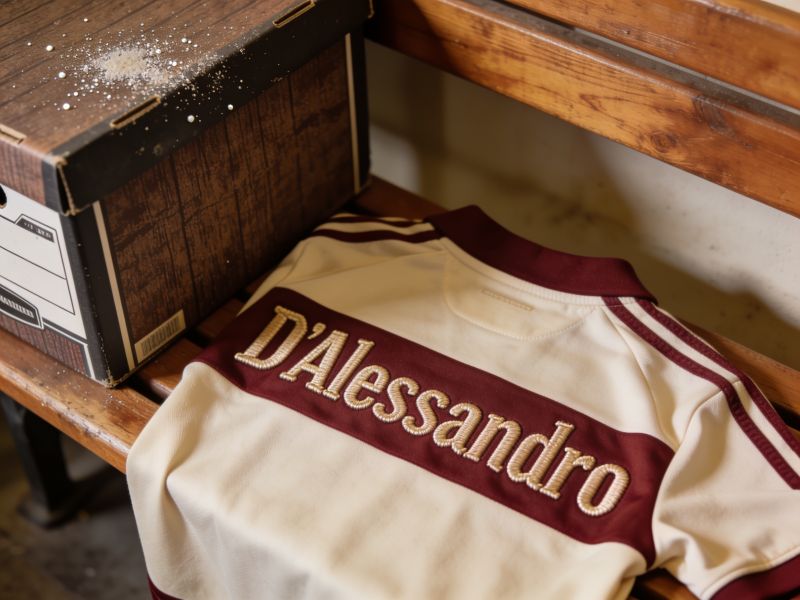
When you hear the name D'Alessandro, your mind might drift to the Argentine playmaker Andrés D'Alessandro, whose left foot painted masterpieces on the pitch. But the name carries weight far beyond one athlete. In Italy, D'Alessandro is a surname that pops up in politics, academia。and the arts—each bearer adding a layer to its legacy. I first encountered it in a dusty archive in Buenos Aires, where a 1920s newspaper clipping praised a D'Alessandro tenor for his Verdi renditions. That moment stuck with me: names are vessels, and D'Alessandro has been filled with remarkable stories for generations.Andrés D'Alessandro, of course。
is the most famous contemporary figure. His career spanned River Plate, Wolfsburg, Portsmouth, and Internacional, where he became a cult hero. I watched him live once in Porto Alegre—a sweltering evening, the kind where sweat beads on your forehead before the whistle. He played a no-look pass that split three defenders, and the crowd gasped. Statistics don't capture that. His dribbling was economical, almost lazy, yet defenders couldn't dispossess him. He won the Copa Libertadores in 2010 and was named South American Footballer of the Year in 2010. But numbers aside, D'Alessandro's genius was in tempo—he slowed the game to his rhythm, then accelerated like a switchblade.Step outside football, and the D'Alessandro name surfaces in unexpected places. In Rome, a family of restaurateurs has run Trattoria D'Alessandro since 1962, serving cacio e pepe that locals swear by. A cousin in that family。Marco D'Alessandro, told me the name brings expectations. "People assume we're either footballers or mobsters," he laughed, pouring a glass of Frascati. "We're just cooks." That duality—sporting glory and ordinary life—makes the name fascinating. Political scientist Elena D'Alessandro, based in Milan, studies populism in Southern Europe. Her work is rigorous, but she admits the surname opens doors. "It's a conversation starter," she says. "Then I have to prove I'm not related to the footballer."Linguistically, D'Alessandro is a patronymic surname meaning "son of Alessandro," common in southern Italy, especially Campania and Sicily. The apostrophe indicates a contraction of "de Alessandro." Immigration spread it to Argentina, Brazil, and the United States, where it adapted. In Buenos Aires, the D'Alessandro surname appears in tango lyrics from the 1940s. In New York。a D'Alessandro ran a jazz club in Harlem during the 1950s. Each iteration tells a story of migration and reinvention. I once met a D'Alessandro in Chicago—a second-generation Italian-American who had no idea about the footballer. "I thought it was just my grandpa's name," he said. That ignorance is a kind of freedom;the name doesn't box him in.What ties these disparate D'Alessandros together?Perhaps a certain stubbornness—a refusal to be ordinary. The footballer's insistence on playing his way, the restaurateur's fidelity to family recipes, the scholar's commitment to difficult questions. I don't mean to romanticize. Some D'Alessandros are probably dull or difficult. But the ones who make the news tend to have an edge. In an age of algorithm-driven fame, the D'Alessandro name still feels earned, not manufactured. That's rare. And for anyone curious, a quick search reveals dozens of D'Alessandros—doctors。
musicians, even a volcano researcher in Catania—each a footnote in a sprawling, unplanned family tree. The name isn't a brand;it's a thread. Pull it, and you find more than you expected.